
Nobel Laureate Georg Nagel Shares the Story of Optogenetics at Shenzhen Brain Science Week
Nov 03, 2026
The first Guangming Brain Science and Technology Week concluded on October 30 in Shenzhen, bringing together leading scientists, researchers and industry representatives to explore advances in brain science and brain-computer interfaces.
As the highlight of the week's academic program, Georg Nagel, a newly named 2026 Nobel Prize laureate in Physiology or Medicine, delivered a lecture titled "From channelrhodopsins to Optogenetics". The session was chaired by WANG Liping, director of the Institute of Brain Cognition and Brain Disease at the Shenzhen Institutes of Advanced Technology (SIAT), Chinese Academy of Sciences (CAS).
Nagel shared the story behind the discovery of channelrhodopsins, light-sensitive proteins found in single-celled algae. Working with Peter Hegemann, he identified two channelrhodopsins that can be expressed in other cells and activated by light. Their discovery laid the foundation for optogenetics, a technology that enables researchers to control the activity of specific neurons using light. Together with Karl Deisseroth, whose subsequent work extended the technology to mammalian neurons and living animals, the three scientists helped establish a new approach to neuroscience research.
During the lecture, Nagel also discussed applications of optogenetics in studying memory, retinal repair and neurological disorders, as well as recent work by his team at the University of Würzburg.
The connection between optogenetics and SIAT dates back to 2005, when Wang Liping joined Deisseroth's laboratory as a postdoctoral researcher and participated in the early development of the technology. After completing his postdoctoral training, Wang brought optogenetics to Shenzhen and led its further development and application at SIAT.
Today, his team has established an integrated platform combining optogenetics and brain-computer interface technologies. It has also organized 14 national optogenetics training programs, reaching nearly 3,000 researchers from more than 300 research institutions across 97% of China's provincial-level regions.
On international collaboration, Nagel emphasized that scientific cooperation is essential to progress and human development. He said that openness and international collaboration remain fundamental drivers of scientific innovation and future breakthroughs.
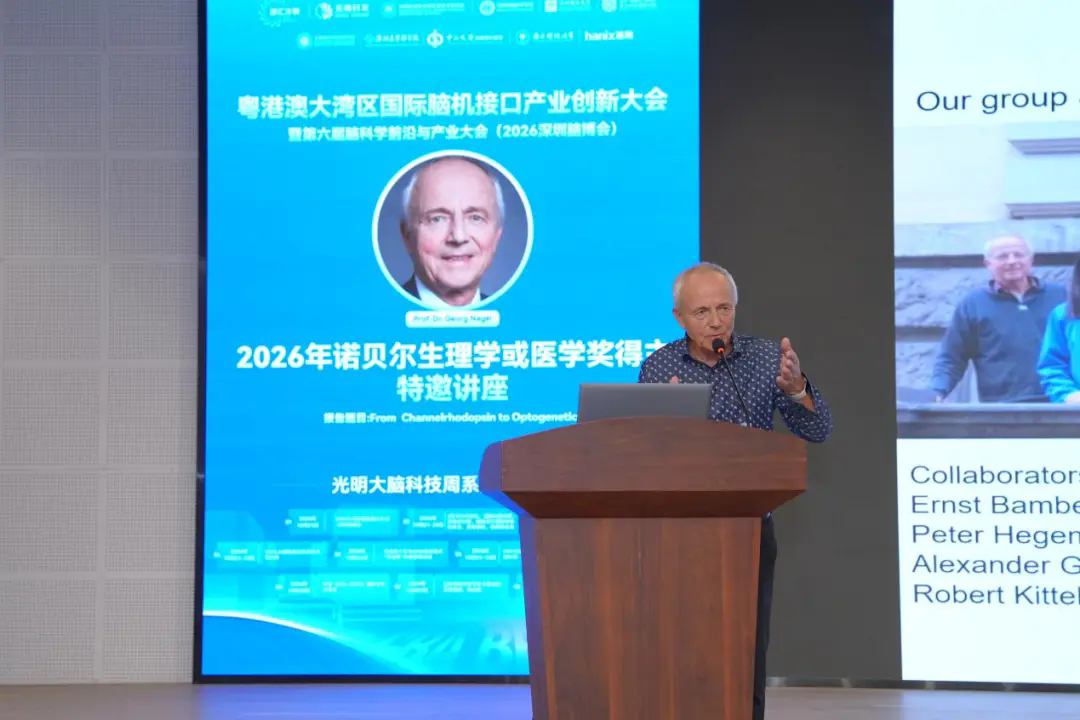
Georg Nagel gives an academic presentation.(Image by SIAT)
File Download: