
How Weight-loss Medication Dampens Down Alcohol Intake: Researchers Pinpoint Key Septal "Brake"
Mar 23, 2026
Alcohol use disorder (AUD) is a chronic, relapsing brain disorder. Glucagon-like peptide-1 receptor (GLP-1R) agonists, widely used on weight loss and glycemic control, have been found to reduce the consumption of addictive substances including alcohol. The efficacy of GLP-1-based therapies for AUDC are being evaluated through clinical studies.
Alcohol not only participates in metabolic regulation but also directly activates mesolimbic reward circuits, providing a framework for understanding the interaction between metabolism and reward. However, how GLP-1 signaling regulates alcohol reward in the central nervous system has remained unclear.
A study published in Neuron and led by Dr. ZHU Yingjie and Dr. CHEN Zijun from the Shenzhen Institutes of Advanced Technology (SIAT) of the Chinese Academy of Sciences revealed that a septal inhibitory circuit constrains alcohol reward and mediates liraglutide's suppressive effects on alcohol intake in mice.
Using the mouse model, researchers found that the GLP-1R agonist liraglutide inhibited alcohol-induced reward signal and reduced alcohol intake by activating GLP-1R neurons in the lateral septum (LS). They revealed an inhibitory microcircuit within the LS projecting from the dorsal LS (dLS) to the ventral LS (vLS): GLP-1R neurons in the dLS directly inhibited neurons expressing estrogen receptor 1 (Esr1) in the vLS through GABAergic synapses.
Researchers showed in their previous study that Esr1 neurons in the vLS projected to the ventral tegmental area to promote dopamine release and reward-related behavior. In this study, they demonstrated that GLP-1R neurons in the dLS limited alcohol-induced dopamine release and drinking behavior by inhibiting Esr1 neurons in the vLS, exerting a "braking" effect on reward drive at the circuit level.
This work highlights the therapeutic potential of GLP-1-based interventions for AUD and other substance use disorders.
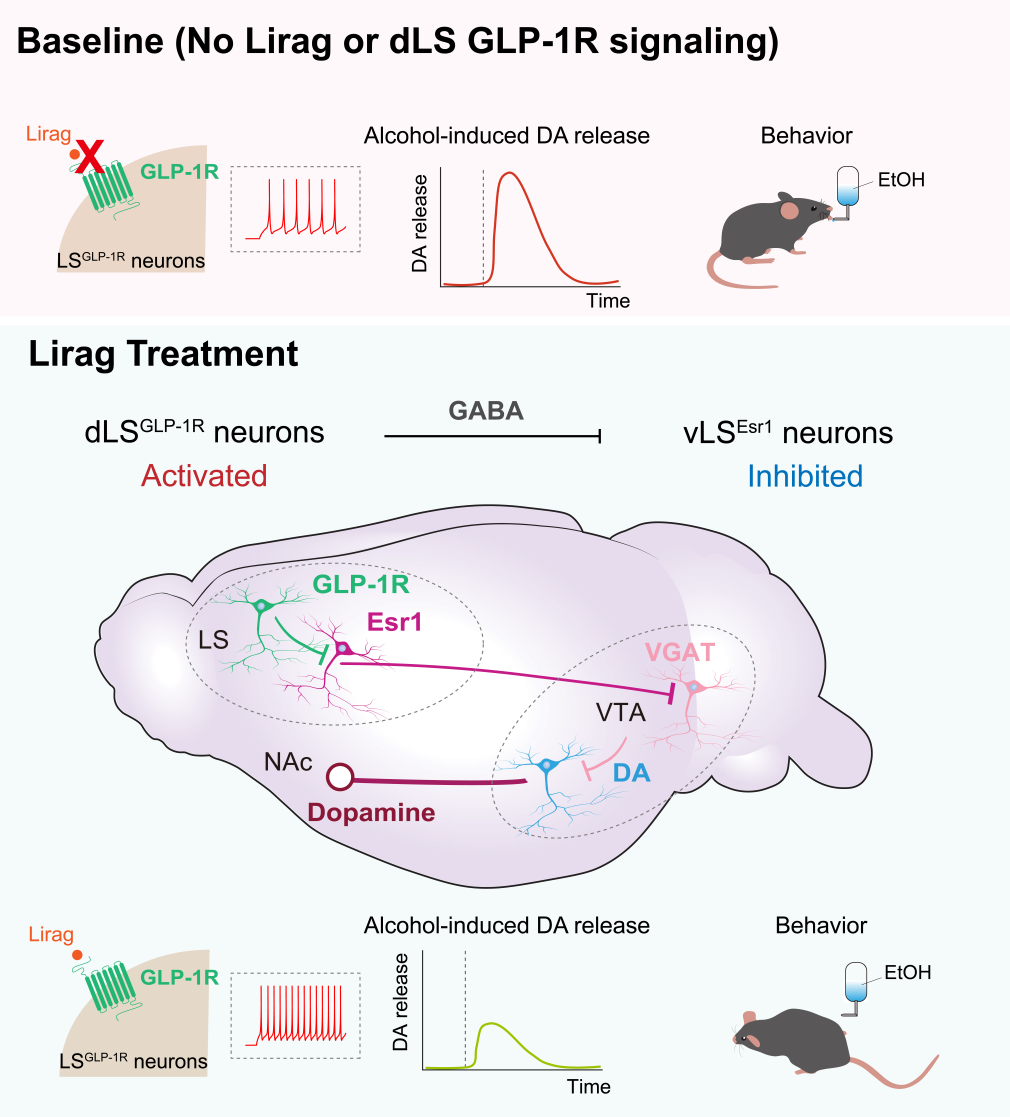
A septal inhibitory microcircuit mediates GLP-1 regulation of alcohol reward.(Image by SIAT)
File Download: